For supervisors, team leaders, coaches and consultants
The five Toyota Kata coaching questions, and how a coaching cycle runs
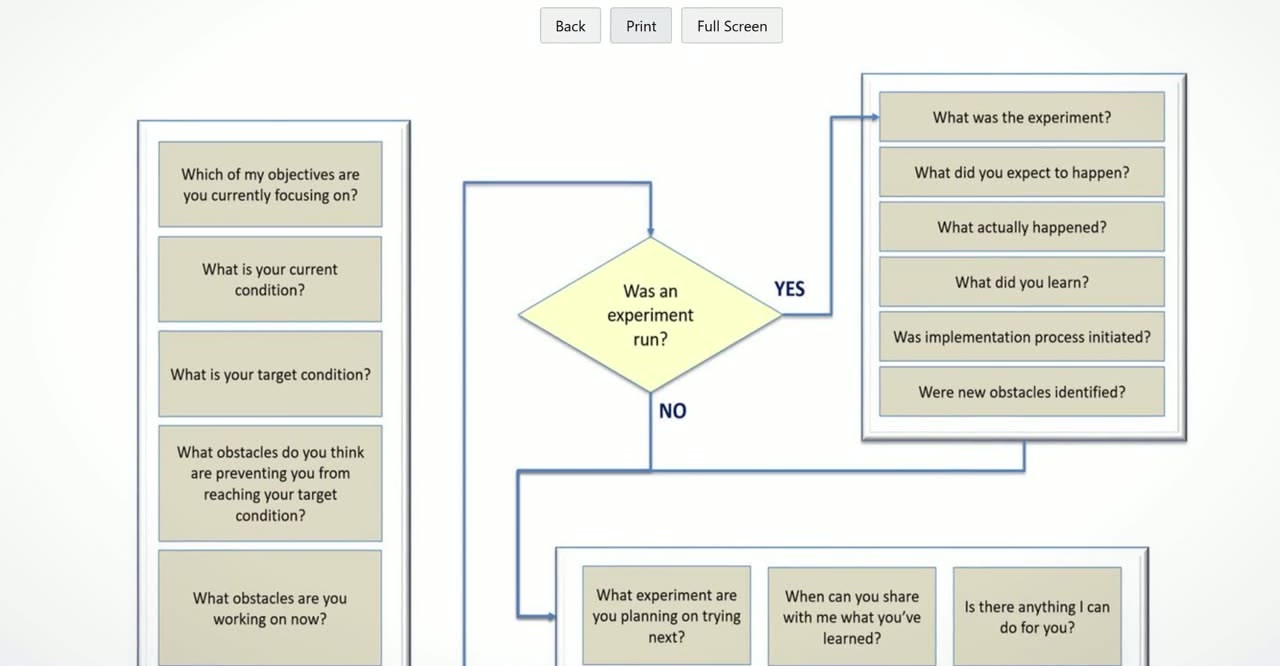
The five Coaching Kata questions are: What is the target condition? What is the actual condition now? What obstacles do you think are preventing you from reaching the target condition, and which one are you addressing now? What is your next step, and what do you expect? When can we go and see what we have learned from taking that step? A coach asks them in a short cycle, often daily, while the learner works toward a target through small experiments.
Published by COPEX · Updated · About 7 minutes to read
The five questions, and what to listen for
- 1
What is the target condition?
A good answer: A description of how the process should work by a set date, with a number to check it by.
The coach listens for: Is it specific enough that we will know on the date whether we got there?
- 2
What is the actual condition now?
A good answer: Today’s facts, measured, in the same terms as the target. Then a look back at the last step: what was it, what did you expect, what actually happened, and what did you learn?
The coach listens for: Did the learner go and look, and did they compare the result with what they expected?
- 3
What obstacles do you think are preventing you from reaching the target condition? Which one are you addressing now?
A good answer: A list of obstacles, and one of them chosen to work on now.
The coach listens for: One obstacle at a time. The list can grow; the focus stays on one.
- 4
What is your next step, and what do you expect?
A good answer: One small experiment, and a prediction of what it will do.
The coach listens for: Without a prediction, nothing can be learned when the result comes in.
- 5
When can we go and see what we have learned from taking that step?
A good answer: A time, soon, usually the next day.
The coach listens for: Short cycles. The sooner the next look, the faster the learning.
The Improvement Kata the questions coach
The questions follow the learner through the four steps of the Improvement Kata:
- 1Understand the direction: the longer-term challenge the work is heading toward.
- 2Grasp the current condition: how the process works today, measured.
- 3Establish the next target condition: how it should work by a date not far ahead.
- 4Experiment toward the target: one small step at a time, each one a plan-do-check-act cycle.
The five questions live in step four. Each coaching cycle checks the last experiment and agrees on the next one.
How a coaching cycle runs
Where and how long
At the learner’s storyboard, close to the work, in usually under 20 minutes. The learner answers; the coach asks and does not hand out solutions. The point is to practise a way of thinking, not to fix today’s problem for the learner.
What gets written down
Every experiment gets one record: the step, what the learner expected, what actually happened, and what they learned. Over weeks, that record shows how the learner’s understanding of the process grew.
Who is involved
The learner, who works on the process. The coach, often the learner’s manager. And from time to time a second coach, who watches the cycle and coaches the coach.
An example cycle
Worked example
A changeover on line 2
A made-up plant with invented numbers, for teaching only.
- Target condition
- By 15 December, a changeover on line 2 takes 30 minutes or less, done by one operator following a written sequence.
- Actual condition
- The last five changeovers averaged 42 minutes. Operators searched for tools.
- Last step
- Put the die-change tools on a shadow board at the press.
- Expected
- No tool search; about 5 minutes saved.
- What happened
- 38 minutes. The tools were there, but the operator waited 6 minutes for the forklift.
- Learned
- The forklift wait is now a bigger loss than the tool search was.
- Obstacle now
- Waiting for the forklift to bring the next die.
- Next step and expectation
- Stage the next die beside the press before the run ends, for tomorrow’s 10:00 changeover. Expect no forklift wait and under 34 minutes.
- Go and see
- Tomorrow at 10:45.
Common mistakes
The coach solves the problem
It feels faster, but the learner learns nothing and comes back with the next problem. Ask the next question instead.
A target that is only an outcome
“Yield 95%” says where to land, not how the process will work. Describe the process too.
Several obstacles at once
Working three obstacles in one step makes the result impossible to read. One at a time.
Skipping “what do you expect?”
Without a prediction there is nothing to compare, so the step teaches nothing.
Steps that are too big
A step that takes two weeks gives one chance to learn in two weeks. Make steps small enough to check tomorrow.
Coaching once a week
Kata is practice. Weekly cycles are too far apart for the habit to form.
In MyGemba AI
Build a Culture of Continuous Improvement
In MyGemba AI, the Toyota Kata module holds the learner’s measurable target condition and obstacles, records each PDCA cycle, and lets the coach review every learner and give feedback.
A way to build a habit of continuous improvement through practice. A team works toward a clear challenge, takes small steps toward a next target and learns from each step through coaching.
- Improvement Kata: a measurable target condition and a parking lot for obstacles
- PDCA cycles record the experiment, the expected result, what happened and the learning
- Coaching Kata: the coach reviews every learner and gives feedback
Build a Culture of Continuous Improvement (Toyota Kata) is $99 a year, with the Toyota Kata and Toyota Production System certifications. It is also part of the OpEx Leader Certification, the full system.
14-day money-back guarantee · Cancel anytime
Opens the MyGemba AI page on the Toyota Kata film and its offer.
Tom Dunn, Creator of MyGemba AI, is a Lean Six Sigma Master Black Belt with 45 years of continuous improvement experience. Every plan comes with the Master Black Belt Level AI Coach.
Questions
Who created Toyota Kata?
Mike Rother described the Improvement Kata and the Coaching Kata in his book Toyota Kata, based on his study of how Toyota develops scientific thinking in its people. The five coaching questions come from that work.
How long should a coaching cycle take?
Short: usually under 20 minutes, at the learner’s storyboard, near the work. It is meant to happen often, ideally every day, so each cycle covers one small step.
What is the difference between the Improvement Kata and the Coaching Kata?
The Improvement Kata is the routine the learner practises to reach a target condition through small experiments. The Coaching Kata is the routine the coach practises to develop the learner, using the five questions. One is about improving the process; the other is about developing the person who improves it.
Can the coach be the learner’s own manager?
Usually, yes. The coach is often the next level up, because developing people is part of a manager’s job. What matters is that the coach asks rather than tells, and that the coach is coached too, by a second coach.
Where the targets come from: the losses on the hour-by-hour board and OEE, and the objectives in the Hoshin Kanri X-matrix.