For CEOs, plant managers and leadership teams
How to fill out a Hoshin Kanri X-matrix
Fill a Hoshin Kanri X-matrix in five passes: your three-to-five-year breakthrough objectives at the bottom, this year’s objectives on the left, the improvement priorities that will deliver them at the top, the metrics and targets on the right, and the owners on the far right. Then mark in each corner which items connect, and review the metrics every month.
Published by COPEX · Updated · About 8 minutes to read
What an X-matrix is
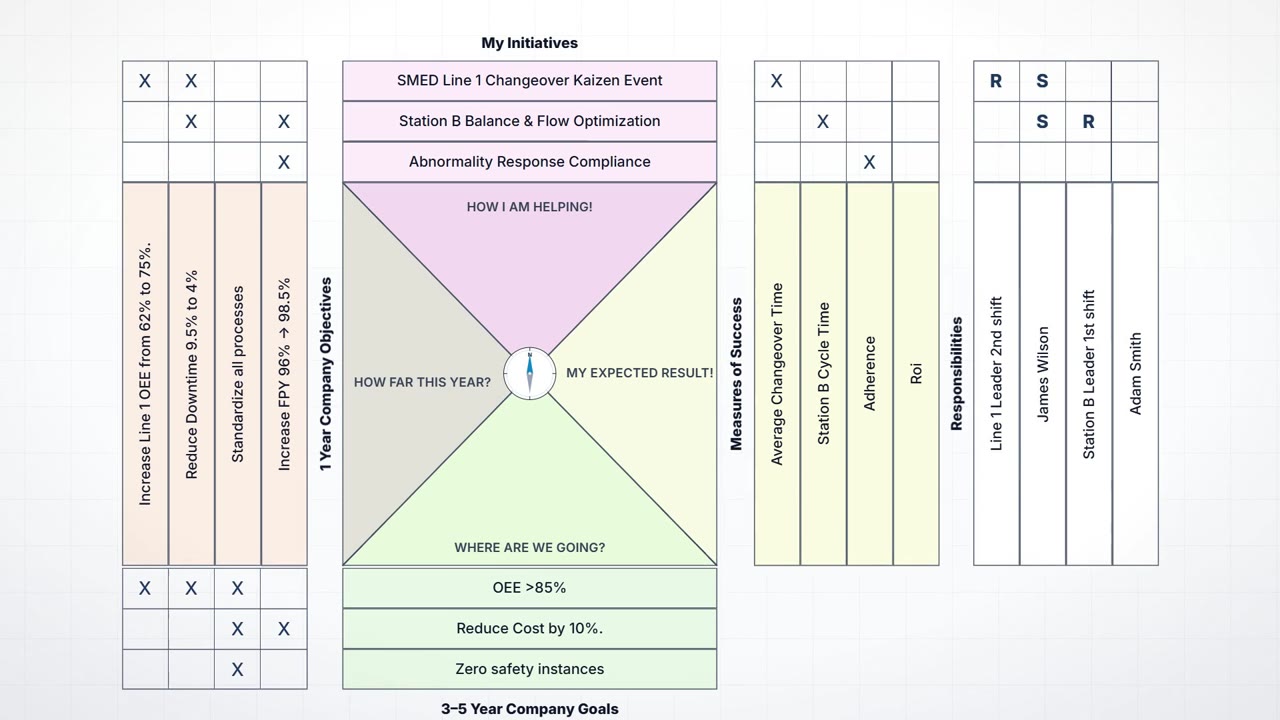
An X-matrix is a one-page view of a Hoshin Kanri plan. Hoshin Kanri, also called strategy deployment or policy deployment, is the yearly process of setting a company’s objectives, deploying them through every level and reviewing progress. The X-matrix puts that plan on a single sheet so anyone can trace a project on the floor back to a company goal, and spot a goal that no project is working on.
- 1Breakthrough objectives (bottom). The three-to-five-year results the company must reach.
- 2This year’s objectives (left). What has to be true at the end of this year to stay on that path.
- 3Improvement priorities (top). The few projects that will deliver this year’s objectives.
- 4Metrics and targets (right). How you will know each priority is working, with a number to reach.
- 5Owners (far right). Who leads each priority and who supports, marked in a small grid of priorities against people.
- The corners are small grids. A mark where a row and a column cross says those two items are linked.
How to fill it out, step by step
Work around the matrix in this order. Each step only uses what the step before it decided.
1. Breakthrough objectives (bottom)
Write three to five results the company must reach in three to five years. They come from the mission, the vision and an honest look at strengths, weaknesses, opportunities and threats. Make them big and directional, such as halving customer lead time, not a list of activities.
2. This year’s objectives (left)
For each breakthrough objective, write what has to be true by the end of this year to be on the path. Each one needs a number and a date. Then mark the bottom-left corner: which annual objective serves which breakthrough objective.
3. Improvement priorities (top)
List the few projects that will move this year’s objectives. These are real improvement efforts with a start and an end, not the routine work of each department. Mark the top-left corner: which priority serves which annual objective.
4. Metrics and targets (right)
For each priority, choose the measure that will show it is working and the target to reach this year. Prefer a measure the team can see move month by month. Mark the top-right corner: which metric tracks which priority.
5. Owners (far right)
List the people or teams down the far right, and in the grid beside the priorities mark who leads each one and who supports it. Every priority needs exactly one leader. A priority with no owner is a wish.
6. Check the connections
Read the corners. Every annual objective should have at least one priority. Every priority should have a metric and an owner. A priority that links to nothing is a candidate to drop; an objective that nothing links to will not happen.
7. Deploy it with catchball
Each manager below builds their own X-matrix, whose objectives come from the priorities of the level above. Agree them in conversation, level by level, rather than handing them down.
An example, filled in
Worked example
A plant that wants to halve its lead time
A made-up plant with invented numbers, for teaching only.
| Part | What the team wrote |
|---|---|
| 1. Breakthrough objectives | Halve customer lead time within three years. Cut the cost of poor quality in half. |
| 2. This year’s objectives | Lead time from 12 to 9 days. Scrap from 4% to 2.5%. |
| 3. Improvement priorities | Pull system in final assembly. Quick changeover on the press line. Standard work at the weld cells. |
| 4. Metrics and targets | Lead time: 12 → 9 days. Press changeover: 55 → 25 minutes. Weld scrap: 4% → 2.5%. |
| 5. Owners | Leads: final assembly manager (pull system), press line supervisor (quick changeover), quality engineer (standard work). Supports: the weld team, maintenance. |
Reading the corners: the pull system and the quick changeover both link to the lead-time objective. Standard work at the weld cells links to the scrap objective, and more weakly to lead time, because less rework means less waiting. Every objective has a priority, and every priority has a metric and an owner.
Keep it alive: the monthly review
An X-matrix filed in January changes nothing. Once a month, each owner shows plan against actual for their metric, month by month. Where a metric is behind, they bring the reason and a countermeasure. Many teams colour each month green or red so the misses stand out. That review is what makes Hoshin Kanri a management system rather than a planning exercise.
Common mistakes
Too many priorities
Ten priorities means none of them gets the people it needs. Choose three to five.
Objectives without numbers
“Improve quality” cannot be tracked. Write where you are, where you will be, and by when.
Marking every corner
If everything links to everything, the matrix tells you nothing. Mark only real, strong links.
Routine work listed as priorities
Running payroll is not an improvement priority. Keep the top part for projects with a start and an end.
No monthly review
Without a monthly look at plan against actual, the plan drifts and the misses are found after the year has closed.
In MyGemba AI
Create and Deploy Strategy Through the Organization
In MyGemba AI, Hoshin Kanri is the first of eight modules. It deploys the strategic objectives; Value Stream then collects the process data, and Opportunities turns that data into improvement work.
An annual process for developing, deploying and achieving strategic objectives. It aligns everyone around shared goals and helps teams review progress, so they can adjust when results miss.
- Create Strategy: mission, vision, SWOT and the goals that link one year to the next five
- Deploy Strategy: an X-matrix for every manager, tied to the company goals
- Track Progress: month by month, where you are on track and where you are behind
Create and Deploy Strategy Through the Organization (Hoshin Kanri) is $199 a year, with the Hoshin Kanri certification. It is also part of the OpEx Leader Certification, the full system.
14-day money-back guarantee · Cancel anytime
Opens the MyGemba AI page on the Hoshin Kanri film and its offer.
Tom Dunn, Creator of MyGemba AI, is a Lean Six Sigma Master Black Belt with 45 years of continuous improvement experience. Every plan comes with the Master Black Belt Level AI Coach.
Questions
What is the difference between Hoshin Kanri and the X-matrix?
Hoshin Kanri is the yearly process of setting, deploying and reviewing strategy. The X-matrix is one tool inside it: a one-page view of the plan that shows how long-term objectives, this year’s objectives, improvement priorities, metrics and owners connect. You can run Hoshin Kanri without an X-matrix, but most teams find the one-page view keeps the plan honest.
How many items should each part of the X-matrix have?
A common rule of thumb is three to five items per part. More than that usually means the leadership team has not yet chosen what matters most, and the people doing the work will spread their effort too thin.
What is catchball in Hoshin Kanri?
Catchball is the back-and-forth between levels when the plan is deployed. Leaders propose objectives, the next level replies with what it can deliver and what it needs, and the plan is adjusted until both sides agree. It turns a plan handed down into a plan people have committed to.
How often should the X-matrix be reviewed?
Review the metrics every month: plan against actual, with a countermeasure wherever a metric is behind. Rebuild the whole matrix once a year, when the next year’s objectives are set.
Next: once the strategy is set, measure the process every hour. See the hour-by-hour board and how to get OEE from it.